Reading Comprehension- Glossary- WEEK4
Reading Comprehension- Glossary- WEEK4
10 HEAT TRANSFER terms
UNIVERSIDAD DE COLIMA----
MICHAEL ANTONIO GAYTAN MEDINA 7A
- Convection heat transfer coefficient
- noun
- Critical Reynold’s number
- noun
- The critical Reynolds number is associated with the laminar-turbulent transition, in which a laminar flow becomes turbulent. This is an extraordinarily complicated process, which at present is not fully understood.
- Example: In determining whether the boundary layer is laminar or turbulent, it is frequently reasonable to assume that transition begins at some location xcrit, as shown in figure. This location is determined by the critical Reynolds number, Rex,crit.
- es: Número crítico de Reynold

- Friction Coefficient
- noun
- is a measure of the amount of friction existing between two surfaces. When you find a coefficient of friction, you're calculating the resistance to motion at the interface of two surfaces of similar or dissimilar materials.
- Example: Often, only a low amount of low COF filler is needed because they are soft materials that become spread out across the polymer surface during use.
- es: Coeficiente de rozamiento

- Kinematic viscosity
- noun
- is the only relevant factor except the given geometric boundaries and boundary velocities that influences the solution of the fluid flow field.
- Example: The diffusion coefficient D, kinematic viscosity v, and the thermal diffusivity α = kpc – where k, p, and c are thermal conductivity, density, and specific heat, respectively – are transport properties and all have the same unit of m2/s.
- es: viscosidad cinemática

- Laminar flow
- noun
- type of fluid (gas or liquid) flow in which the fluid travels smoothly or in regular paths, in contrast to turbulent flow, in which the fluid undergoes irregular fluctuations and mixing.
- Example: type of fluid (gas or liquid) flow in which the fluid travels smoothly or in regular paths, in contrast to turbulent flow, in which the fluid undergoes irregular fluctuations and mixing.
- es: Flujo laminar

- Nusselt number
- NOUN
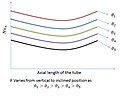
- is a dimensionless number that measures the increase in heat transfer from a surface through which a fluid flows (heat transfer by convection) compared to the heat transfer if it occurred only by conduction.
- Example: Nusselt number on the other hand is a non-dimensional heat transfer coefficient. It is used to determine whether the heat transfer is conduction or convection.
- es: NÚMERO DE NUSSELT
- Prandtl number
- NOUN
- is a dimensionless number proportional to the quotient between the diffusion rate of the amount of moment (viscosity) and the thermal diffusivity.
- Example: Fluids with small Prandtl numbers are free-flowing liquids with high thermal conductivity and are therefore a good choice for heat conducting liquids.
- es: número de Prandtl

- Reynold number
- NOUN
- is a dimensionless number used in fluid mechanics, reactor design, and transport phenomena to characterize the motion of a fluid. Its value indicates whether the flow follows a laminar or turbulent pattern.
- Example: The Reynolds number has wide applications, ranging from liquid flow in a pipe to the passage of air over an aircraft wing.
- es: Numero de Reynold

- Shear stress
- noun
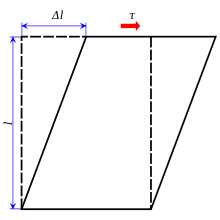
- is the component of stress coplanar with a material cross section. It arises from the shear force, the component of force vector parallel to the material cross section.
- Example: Thus, the maximum shear stress will occur either in the web of maximum shear flow or minimum thickness
- es: tension cortante
- Turbulent flow
- noun
- type of fluid (gas or liquid) flow in which the fluid undergoes irregular fluctuations, or mixing, in contrast to laminar flow, in which the fluid moves in smooth paths or layers.
- Example: Common examples of turbulent flow are blood flow in arteries, oil transport in pipelines, lava flow, atmosphere and ocean currents, the flow through pumps and turbines, and the flow in boat wakes and around aircraft-wing tips.
- es: flujo turbulento
